
Security Is Not a Feeling: How Executives Actually Know They're in Control
Key Takeaways
Most executives I speak with are thoughtful, disciplined, and deeply invested in protecting their firms. When cybersecurity comes up, the response is often calm and confident.
Most executives I speak with are thoughtful, disciplined, and deeply invested in protecting their firms. When cybersecurity comes up, the response is often calm and confident:
_“We’re in good shape. We have strong IT.”
That confidence is understandable. There are tools in place. Vendors are engaged. Reports look reassuring.
But here’s the uncomfortable truth:
Security is not a feeling. And confidence, on its own, is not control.
The Gap Between “Having IT” and Being in Control
In regulated financial services firms, cybersecurity is often treated as a capability you possess rather than a condition you continuously verify.
You buy tools. You hire smart people. You assume the system is working as intended.
But control isn’t about what exists in your environment. It’s about what you can explain — clearly, calmly, and without scrambling — when it matters.
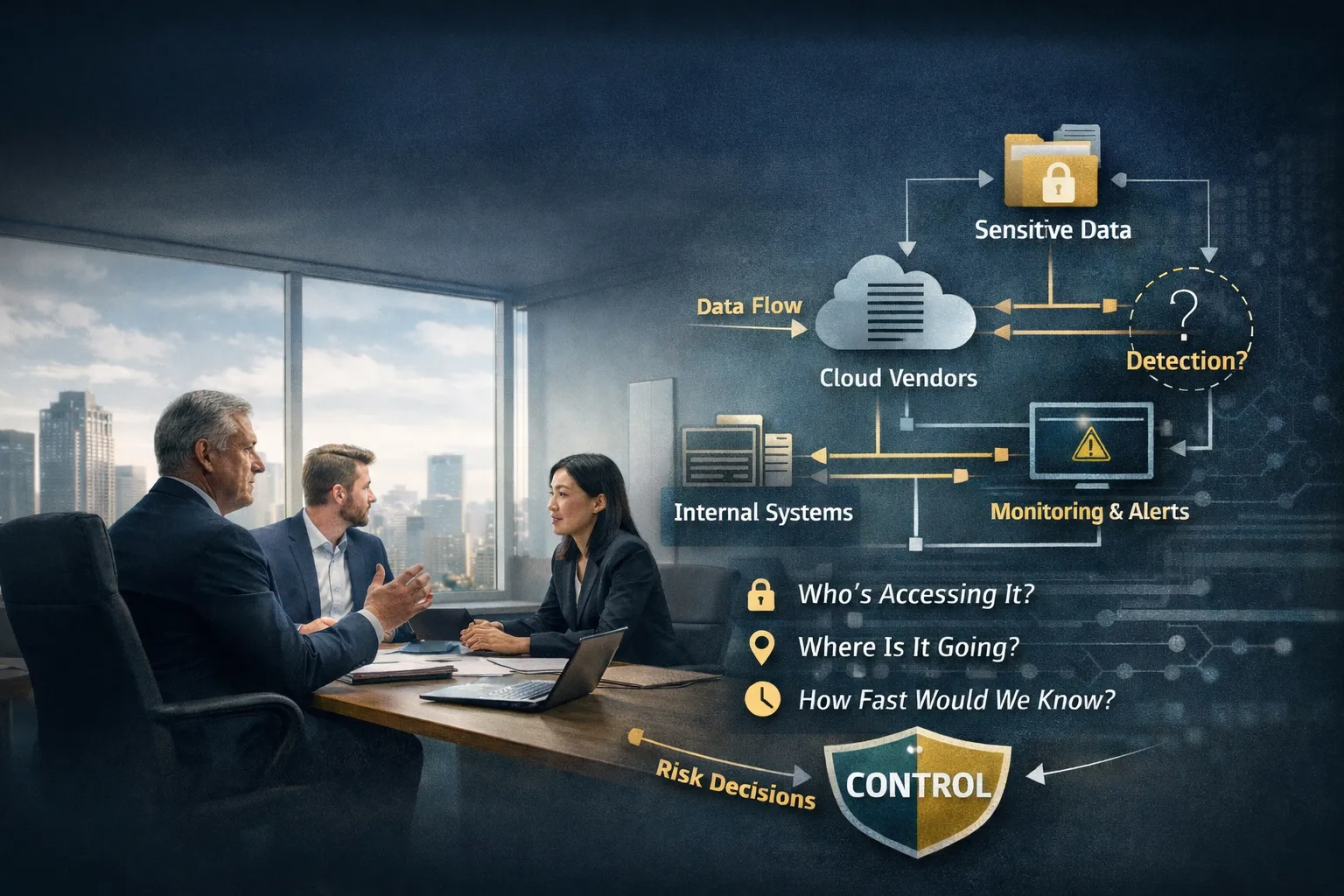
If someone asked you today:
- Who has access to your most sensitive data
- Where that data flows outside your organization
- Which vendors can touch it
- And how quickly you would know if something unusual occurred
Could you answer confidently… without checking with someone else?
That question — the ability to answer it — is the dividing line between confidence and control.
Why Tools Create Comfort (But Not Clarity)
Modern firms are saturated with security technology. Firewalls, endpoint protection, email filtering, monitoring platforms — all valuable, all necessary.
But tools have a side effect: they feel like progress.
They generate dashboards, alerts, and reports. They give the impression that risk is being handled somewhere else.
The problem is that tools don’t reduce risk on their own. They only reduce risk when they are tied to decisions, processes, and ownership.
A tool becomes a control only when it answers specific questions:
- Who is allowed to do this?
- Who reviews it, and how often?
- What happens if it fails?
- How fast would we notice?
If a tool can’t be mapped to a business decision or a clearly defined process, it may still be useful — but it is not providing control.
This is where many firms unknowingly drift: They accumulate technology, but they don’t accumulate clarity.
What Real Control Looks Like to Executives
Executives don’t need technical depth to assess cybersecurity maturity. They need situational awareness.
In firms that are truly in control, leadership can answer questions like:
- “Where are our highest-risk workflows?”
- “Which risks have we deliberately accepted — and why?”
- “Who owns decisions when something breaks?”
- “What would fail first in a bad scenario?”
These answers don’t require perfection. They require honesty, documentation, and repetition.
Control isn’t about eliminating uncertainty. It’s about reducing surprise.
The Danger of “Nothing Has Happened”
One of the most reassuring — and misleading — statements firms make is:
“We haven’t had any incidents.”
In practice, most firms don’t discover issues because their defenses sounded an alarm. They discover them accidentally:
- An email that reached the wrong inbox
- A vendor who retained access longer than intended
- A file shared externally without realizing it
The absence of incidents often reflects a lack of detection, not a lack of risk.
This is especially true in financial services, where trust-based workflows, speed, and discretion are cultural strengths — and security weaknesses.
Real control means knowing where silent failures could exist, even if nothing has exploded yet.
Security as a Leadership Discipline
Cybersecurity is often delegated because it feels technical. But at its core, it is a leadership discipline.
Every meaningful security decision is actually a business decision:
- How much friction is acceptable in exchange for protection
- Which vendors are trusted — and under what conditions
- How quickly the firm prioritizes clarity over convenience
When leadership is disengaged, IT teams are forced to guess what level of risk is acceptable. That’s how inconsistency creeps in. That’s how undocumented decisions accumulate.
Strong firms don’t ask leadership to manage technology. They ask leadership to define tolerance, own tradeoffs, and support discipline.
Confidence That Holds Up Under Pressure
The firms that navigate incidents, exams, and diligence smoothly don’t do anything flashy.
They are boring in the best way possible.
They review access regularly. They document decisions even when it feels unnecessary. They rehearse uncomfortable scenarios without drama.
Most importantly, they don’t confuse reassurance with readiness.
Their confidence isn’t emotional. It’s structural.
And when pressure arrives — from investors, regulators, or reality — that structure is what holds.
Final Thought
Cybersecurity maturity doesn’t announce itself with sophistication. It reveals itself through clarity.
If your confidence is grounded in visibility, ownership, and evidence, it will endure scrutiny. If it’s grounded in assumptions and good intentions, it will eventually be tested.
Security is not a feeling. It’s knowing — quietly and calmly — that you’re in control.